
Sandy peer Lord Naseby reveals how Bedford School inspired his new Oliver Cromwell book
A former MP with longstanding connections to Sandy has revealed how his fascination with Oliver Cromwell began during history lessons at Bedford School, inspiring him to write a new book about the controversial historical figure.
Lord Michael Naseby, whose full peerage title is Baron Naseby, of Sandy in Bedfordshire, has published Cromwell: Parliament's Crusading Politician, drawing on more than five decades of experience at Westminster.
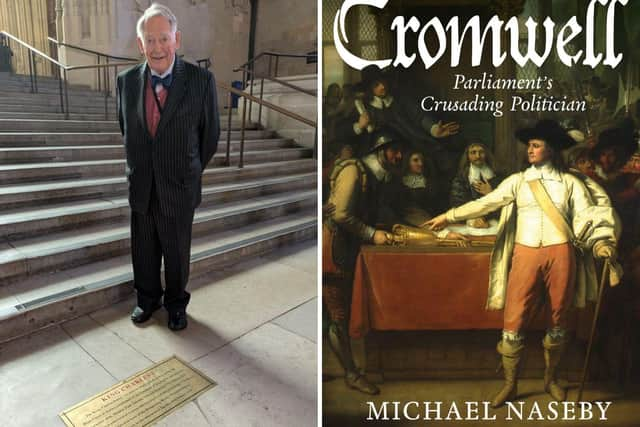

The former Conservative MP for Northampton South, who represented the constituency from 1974 to 1997, has longstanding ties to Sandy, where he has had a home and retains woodland interests.
His peerage title also reflects his interest in the English Civil War. When he entered the House of Lords in 1997, he adopted the name Naseby, associated with the decisive 1645 battle in which Parliament's forces defeated the Royalists.
His new book examines Cromwell's role in shaping parliamentary government and challenges some of the negative perceptions surrounding the 17th-century military and political leader.
Lord Naseby said his fascination with the subject began while studying the English Civil War for A-level history at Bedford School.
He said: "At Bedford School the A level history syllabus covered the Civil War period, and I found it fascinating."
His interest continued through visits to Cromwell's former home in Ely and the Cromwell Museum in Huntingdon.
Lord Naseby later served as chairman of Bedford School's governors from 1988 to 2002.
After being elected to the House of Commons in 1974, he became increasingly aware of criticism directed at Cromwell by fellow parliamentarians.
Some blamed Cromwell for the execution of King Charles I, while others portrayed him as a ruthless Puritan leader.
Asked how his parliamentary career had shaped his views, he replied: "The answer is a lot."
He pointed to similarities between their backgrounds, saying: "We both represented this part of Eastern England and both went to Cambridge University."
His time at Westminster also brought him face to face with one of the most significant documents in British parliamentary history.
"Hanging in the 'NO' lobby was the 'Death warrant for King Charles I', showing Cromwell's signature as the third signatory," he recalled.
But it was his research into historical parliamentary records that led him to reassess Cromwell's political legacy.
He said his research revealed Cromwell's willingness to champion causes affecting his constituents.
"Cromwell was prepared to take up all sorts of causes that affected his constituents regardless of their religion," he said.
Lord Naseby argued that Cromwell challenged the belief that the monarch had an unquestionable right to control Parliament.
"Cromwell was not prepared to accept that the King had by divine right the unique power to summon Parliament," he said.
Charles I ruled without Parliament for 11 years, between 1629 and 1640, a period commonly known as the Personal Rule.
Lord Naseby believes Cromwell's subsequent influence on parliamentary government has been underestimated.
"With the King dead Cromwell in the subsequent years fashioned a Parliamentary system most of which is still traceable to Cromwell," he said. "Our unique Parliamentary Democracy is largely due to Cromwell."
Cromwell: Parliament's Crusading Politician, published by Unicorn Publishing Group, is available in hardback, priced at £20.